Hearts and Hard Conversations

How to Speak Up When Progress Isn’t Happening
By February, many parents reach a quiet realization:
Something isn’t working—and I can’t keep waiting.
The school year is far enough along to see patterns. Progress reports are in. Data has (or hasn’t) been shared. And despite everyone’s best intentions, your child may not be making the gains you hoped for.
This is often the moment when parents face the hardest part of advocacy: starting a difficult conversation.
At Falcon Sky, we want you to know this—speaking up is not a failure of collaboration. It’s part of it.
When “Waiting It Out” Stops Making Sense
Parents often delay hard conversations because they’re trying to be patient, respectful, and cooperative. But concerns tend to surface when:
IEP goals haven’t changed despite limited progress
Services are technically in place, but outcomes aren’t improving
Communication feels vague or overly reassuring without data
You’re told, “Let’s give it more time,”—again
At this stage, many parents feel torn between trust and intuition. That tension matters.
Under IDEA, parents have the right to request meetings, review progress data, and ask for changes when a plan is not producing meaningful benefit. Waiting is not required when concerns are reasonable.
Why These Conversations Feel So Hard
Hard conversations are rarely about one meeting or one service. They’re about fear, responsibility, and the weight of advocating for your child.
Parents often worry:
Will I damage the relationship with the team?
Will I be seen as difficult?
What if I’m wrong?
These fears are understandable—but they shouldn’t keep you silent.
Advocacy doesn’t require confrontation. It requires clarity.
Documentation as a Boundary-Setting Tool
This is where a Communication Log becomes more than a record—it becomes support.
When concerns are documented:
Conversations stay focused on facts, not emotions
Patterns become visible over time
You don’t have to rely on memory or “how it felt”
You can reference what’s already been discussed
A communication log helps you move from “I feel like…” to “Here’s what has been happening.”
That shift matters.
What to Document Before Initiating a Hard Conversation
Before requesting a meeting or raising concerns, it helps to review your log and note:
When progress concerns were first raised
What responses were provided
Any timelines that were suggested
What data (if any) has been shared
Whether follow-ups occurred
This preparation allows you to initiate the conversation with calm authority—not urgency or frustration.
How to Start the Conversation (Without Escalating)
Initiating a hard conversation doesn’t require perfect wording. It requires grounded framing.
Examples of advocacy-centered language:
“I’d like to revisit progress on this goal and review the data together.”
“We’ve given this approach time, and I’m not seeing the growth we expected.”
“Can we talk through what adjustments might be appropriate at this point?”
These statements are clear, respectful, and focused on outcomes—not blame.
Using the Communication Log During the Conversation
During meetings or follow-ups, your communication log helps you:
Reference prior discussions accurately
Clarify what was agreed upon
Document new next steps in real time
Reduce the emotional load of the conversation
It creates continuity—especially when conversations feel repetitive or unresolved.
When Boundaries Are Necessary
Sometimes, hard conversations aren’t just about progress—they’re about boundaries.
A communication log supports boundary-setting when:
Concerns are repeatedly dismissed
Requests go unanswered
Information is withheld or delayed
Verbal assurances don’t match written plans
Boundaries aren’t threats. They’re clarity about expectations and accountability.
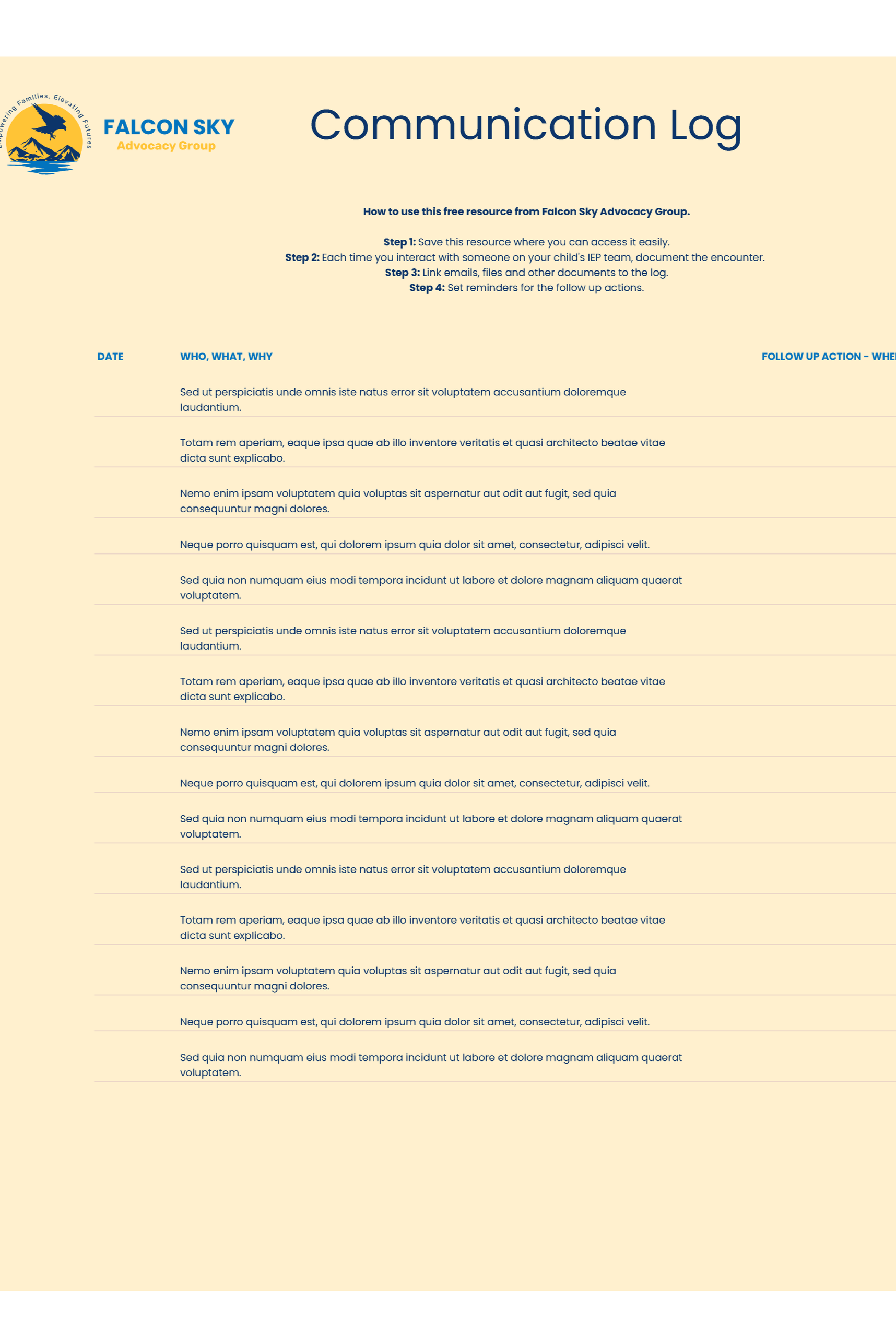
A successful advocate has the right tools:
If you’re preparing to initiate a difficult conversation—or feel one coming—we’ve created a Communication Log designed to support clarity and accountability.
Advocacy Is an Act of Care
Hard conversations are not a sign of failure. They are often a sign that a parent is paying close attention.
Advocacy rooted in care, documentation, and clarity protects both the child and the process.
You’re allowed to ask questions.
You’re allowed to request change.
You’re allowed to expect meaningful progress.
Need Support Before Starting the Conversation?
If you’re unsure how to frame concerns, interpret progress data, or decide next steps, Falcon Sky is here to help.
You don’t have to carry these conversations alone.
Explore our services or schedule a Discovery Call to talk through your situation.
A special education advocate plays a critical role in ensuring that children with special needs receive the education they deserve. At Falcon Sky Advocacy Group, we’re here to make that process easier for families and schools alike. Whether you need help preparing for a meeting, understanding your legal rights, or advocating for the right services, we’re committed to walking alongside you every step of the way.
Let us be your guide through the process. Reach out to Falcon Sky today and start building a path forward for your child’s success.
